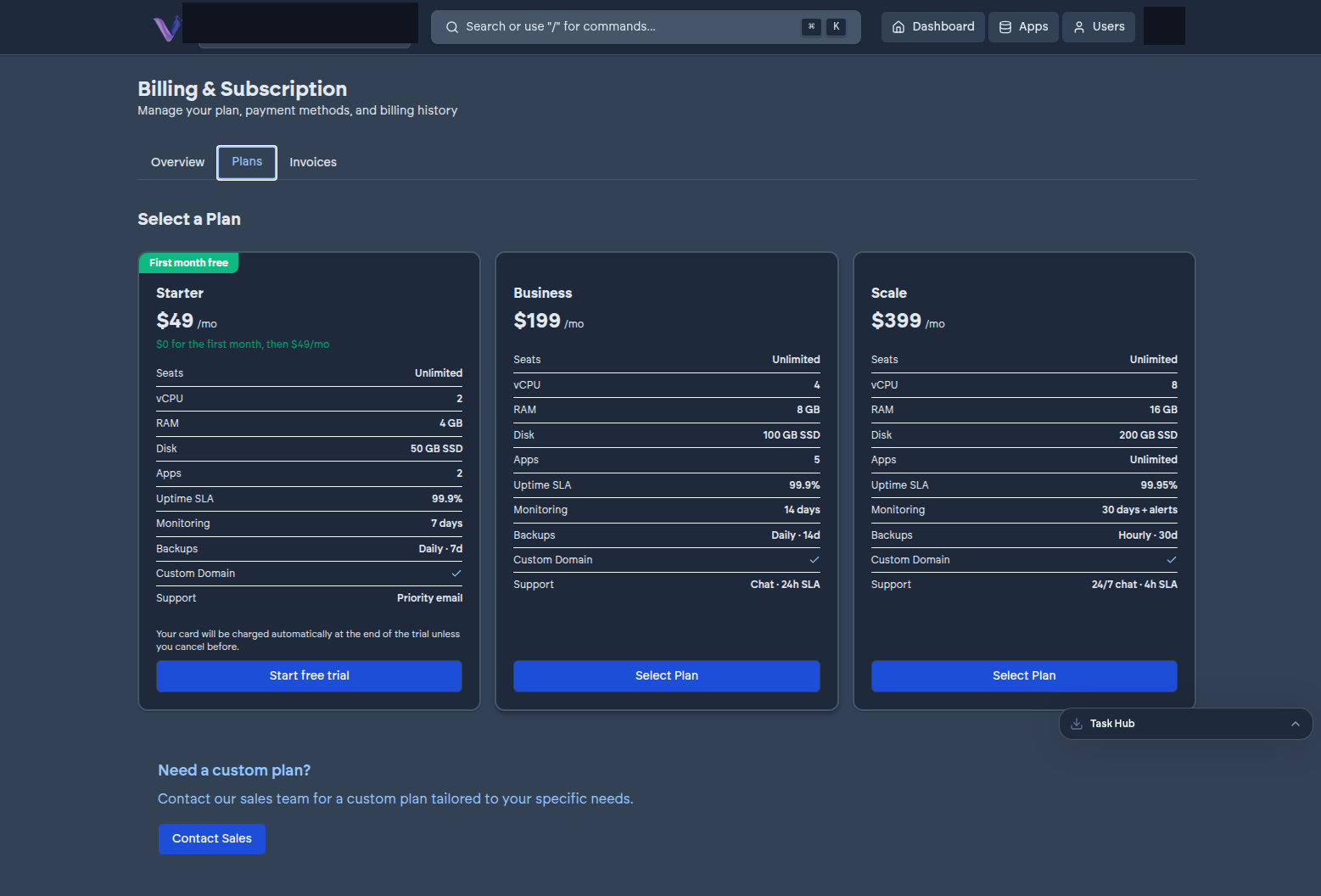
VCloud sits in a specific spot among the ways a team can run open-source software, and it is worth being explicit about the trade-offs rather than letting the product page do the only talking.
Managed, not self-managed#
Self-managed options - a server you provision yourself, or tooling that makes installing and updating open-source apps easier on hardware you run - still leave you holding the server: its patches, its disk, its uptime, and who gets paged when it goes down. VCloud removes that side entirely - nobody on your team operates infrastructure, which is also why VCloud can carry an uptime commitment and publish security controls it can actually stand behind. If your team wants root access and is happy to be on call for it, that is a genuine reason to choose a self-managed option instead; VCloud does not offer a middle ground where you get both a managed bill and a shell. For how VCloud lines up against a specific alternative, see the Cloudron comparison.
One bill for a focused catalog, not per-service pricing across a huge one#
Some managed-hosting providers price per deployed service and support deploying into a cloud account you hold yourself, backed by a very large catalog of possible applications. VCloud instead prices the compute allocated to your organization as a single bill, includes every app in its catalog at no extra cost, and only runs on infrastructure it operates itself - it does not deploy into a cloud account you provide, and has no plan to. The trade-off is catalog size: VCloud's list of applications is smaller and growing, each one extended with the same sign-on and backup treatment, rather than the widest possible menu of upstream software as-is.
Built for teams, not metered for individuals#
Usage-based hosting aimed at individuals and small personal projects is genuinely the cheapest way to run one small instance, and VCloud does not try to compete with that price. VCloud is priced and supported for a team: a fixed monthly plan rather than billing by the resource-hour, an uptime commitment, a support response commitment that gets faster on higher tiers, and backup retention long enough to matter for a business rather than a hobby project. If you want a single low-cost personal instance with no SLA, that is a legitimate reason to look elsewhere.
Where to look for specifics#
The exact shape of these trade-offs - plan pricing, app counts, catalog size, uptime commitments, backup retention - changes over time and is kept current on the marketing site rather than duplicated here, where it could quietly go stale. See: