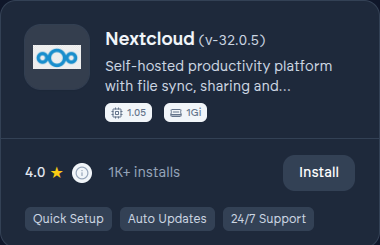
Nextcloud on VCloud is a self-hosted productivity platform: file sync and share, calendars, contacts, collaborative document editing, and video calls. It's the most widely deployed open-source alternative to Google Drive or Dropbox for file storage.
Before you install#
Nextcloud is usually storage-bound rather than compute-bound - the deciding factor for which plan tier fits is how much file data you expect to hold, more than raw processing power. See Plans for how storage allowance scales across tiers.
Installing it#
- From the App Store, find Nextcloud and select Install.
- Choose organization scope for a shared team drive, which is the common case.
- Wait for the deployment to finish - see Deployments.
- Select Open once running. You're signed in automatically with your VCloud account.
What VCloud adds on top of upstream Nextcloud#
- Single sign-on for the web interface and for every sync client that supports it.
- Backups that snapshot the file data and the underlying database together, consistently - a mismatch between the two after a restore is what produces orphaned files on a self-managed instance, and VCloud's backups are taken to avoid that.
- Valid, automatically renewed TLS, without which desktop and mobile sync clients simply refuse to connect.
- Version upgrades handled for you, in the correct order - Nextcloud does not support skipping major versions either.
Using the official clients#
Because your instance has a real domain with valid TLS, the official Nextcloud desktop client, and the iOS and Android apps, connect the same way they would to any Nextcloud server. Any standard WebDAV, CalDAV, or CardDAV client also works.
Migrating in#
Move files over with the Nextcloud desktop client or a general-purpose sync tool. If you're consolidating from another Nextcloud instance, its built-in user migration tooling can move accounts across with their settings intact.